Uncategorized

arnold on Aug 27, 2024
Achieving Top Quality Scores: The Power of Campaign and Ad Group Design in Google Ads
In Google Ads, account structure isn’t just an organizational preference—it directly affects your costs and performance. That’s because a well-structured account is the fastest path to a high Quality Score, one of the most important factors in determining ad visibility and cost-efficiency.
Quality Score is Google’s internal rating (on a scale from 1 to 10) that measures the relevance and effectiveness of your keywords, ads, and landing pages. It plays a pivotal role in how your ads are ranked and how much you pay per click (CPC). The higher your score, the more visibility you get—and the less you have to pay for it.
Why Quality Score Matters to Google
Google’s revenue depends on delivering relevant results—both organic and paid. In 2023 alone, the company earned over $237.85 billion from advertising, accounting for more than 77% of its total revenue and powering over 91% of global search queries.
If advertisers could easily manipulate ad placements to appear on irrelevant searches—like a carpet store trying to rank for “epoxy flooring contractor Fort Collins”—the user experience would suffer. People would stop trusting the results, and over time, Google would lose traffic, which threatens its entire business model. This is where Quality Score comes in. It helps Google ensure that ads are relevant, trustworthy, and aligned with user intent.
How Quality Score Works in the Ad Auction
Each time a user searches, Google runs an ad auction to determine which ads are shown and in what order. Quality Score is a key part of this, alongside your bid. But Ad Rank (the actual score that determines your position) is not just your bid—it’s your bid × Quality Score, plus other auction-time factors like ad extensions and device context.
Example:
- Company A: Bids $4.00 with a Quality Score of 9 → Ad Rank = 36
- Company B: Bids $6.00 with a Quality Score of 6 → Ad Rank = 36
- Company C: Bids $5.00 with a Quality Score of 7 → Ad Rank = 35
Even though Company A bids less than Company B, they’re tied due to a better Quality Score. If A uses stronger ad extensions or better landing pages, they may even edge out B entirely.
The Three Components of Quality Score
- Expected Click-Through Rate (CTR): Based on historical data, how likely is your ad to get clicked?
- Ad Relevance: How closely does your ad text match the user’s search intent?
- Landing Page Experience: Does the page deliver on the ad’s promise? Is it fast, mobile-friendly, and clear?
Why Account Structure Matters
A well-structured Google Ads account ensures your ads match searcher intent with precision. It connects four key elements: search query, keyword, ad copy, and landing page. Here’s how the hierarchy works:
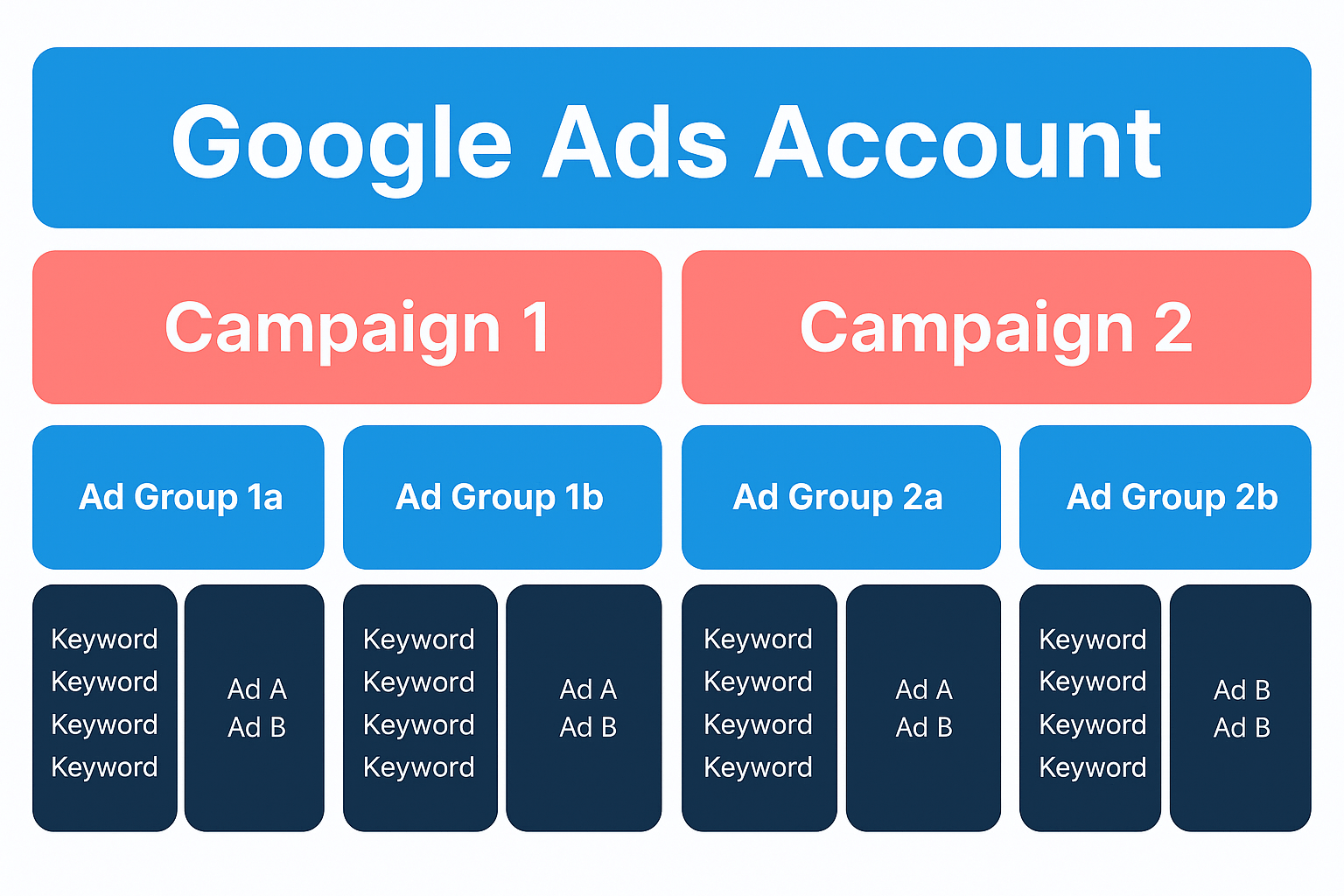
- Account → Contains campaigns, billing, and user access
- Campaigns → Control budget, geo-targeting, and bidding
- Ad Groups → Contain tightly themed keywords and matching ads
- Keywords & Ads → The creative and targeting execution
Role of Campaigns
Campaigns define your top-level strategy. Most importantly, geo-targeting lives here. For example:
- Campaign 1: Residential Painting (Fort Collins)
- Campaign 2: Residential Painting (Denver)
You can exclude overlapping zip codes to avoid bidding against yourself. You’ll also use campaigns to allocate budget, define bidding strategy, and test different service lines.
Role of Ad Groups
Each ad group should focus on one service or theme. If you offer epoxy floors, you might have:
- Ad Group 1: Epoxy Garage Floors
- Ad Group 2: Commercial Epoxy Flooring
Each ad group should send traffic to a dedicated landing page and use ad copy that includes the core keywords.
The Dangers of Poor Ad Group Design
Poorly structured ad groups dump unrelated keywords into one bucket. For example, combining “concrete staining,” “garage floor repair,” and “epoxy coating” in a single group forces your ad to generalize, reducing its relevance for each term. That leads to lower CTR, higher CPC, wasted spend, and lower conversion rates.
The Power of Well-Structured Ad Groups
In contrast, tightly themed ad groups let you write highly specific ads that match a focused landing page. Google rewards this with a higher Quality Score, meaning better performance at a lower cost.
Should You Use SKAGs?
Single Keyword Ad Groups (SKAGs) are one way to take this to the extreme. Each ad group contains just one keyword—allowing 100% message match between the query, ad, and landing page.
Pros:
- Maximum control
- High Quality Score
- Easy testing
Cons:
- Time-consuming to manage
- May limit ad platform learning
- Google now favors broader ad structures with Responsive Search Ads (RSA)
Verdict: Use SKAGs selectively—for proven winners that drive revenue and conversions.
Use Ad Extensions to Boost CTR
Google rewards ads that get clicked. One of the fastest ways to improve click-through rate is by using ad extensions. These include:
- Sitelinks – Links to specific pages on your site
- Callouts – Extra text to highlight benefits (“Free Estimates”)
- Structured Snippets – Lists of services or features
- Call Extensions – Click-to-call functionality
- Location Extensions – Link your Google Business Profile
Using extensions makes your ad more useful and more prominent—both of which increase CTR and improve your Quality Score.
Quick Checklist
- One theme per ad group
- One landing page per ad group
- Query, ad, and page all speak the same language
- Separate campaigns by geography or service line
- Use ad extensions to boost visibility and CTR
- Track at least one conversion per campaign
- Watch Quality Score and optimize based on its components
Conclusion
Google Ads success starts with structure. By organizing your account with purpose—targeting the right services, in the right locations, with tightly aligned keywords and landing pages—you unlock higher Quality Scores and stronger results. Structure isn’t busywork. It’s the lever that makes your entire strategy more efficient and more profitable.