
Uncategorized

arnold on May 01, 2026
Welcome to the end-of-course recap. If you’ve been paying attention, you know we don’t do fluff, we don’t rely on textbooks, and we certainly don’t do “death by PowerPoint.” We build lead generation machines.
When you step out into the real world and start managing actual client dollars, theory goes out the window. What matters is generating profitable action. Whether you are running campaigns for a local service business or a national brand, the foundational rules of Google Ads remain exactly the same.
If you want an account that prints leads instead of burning cash, here are your non-negotiable, evergreen course takeaways.
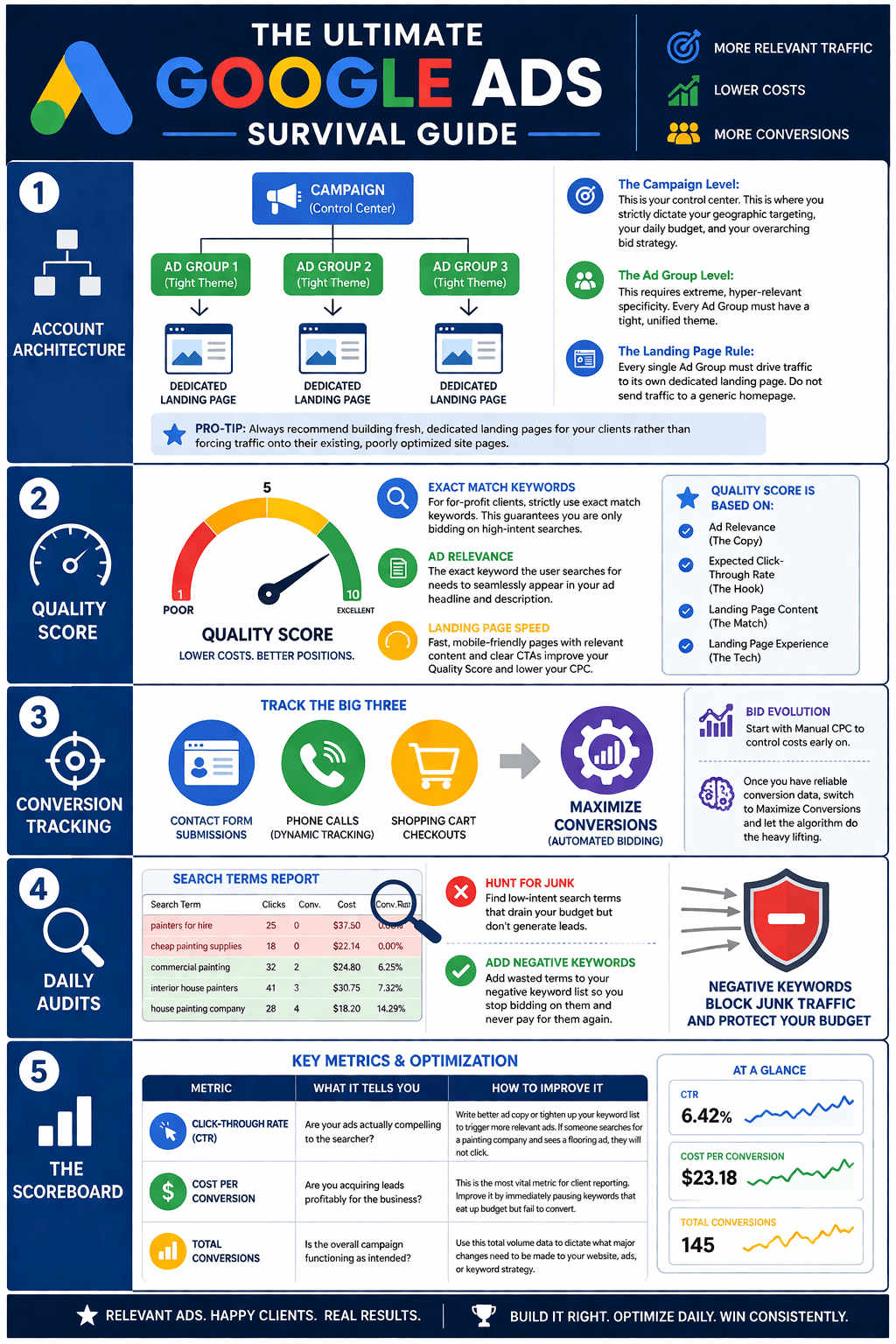
1. Account Architecture: Strict Structure is Everything
Structure dictates success. If you build a sloppy, disorganized account, you will bleed money before your ads even have a chance to perform.
-
The Campaign Level is for Control: This is your command center. You must use the campaign level to strictly dictate your geographic targeting, your daily budget, and your overarching bid strategy.
-
Ad Groups Demand Specificity: Ad groups must be hyper-relevant and tightly themed. Do not lump different services together.
-
The Golden Landing Page Rule: Every single Ad Group must drive traffic to its own dedicated landing page. Do not send paid traffic to a generic homepage. Always recommend building fresh, dedicated landing pages for your clients so the post-click experience exactly matches the pre-click promise.
2. Quality Score: The Ultimate Cost-Saver
Google rewards relevance. Your Quality Score directly dictates how much you pay per click and where your ad ranks on the search engine results page. A high score means you get a discount; a low score means you are paying a premium just to show up.
-
The Match Type Mandate: For for-profit clients, strictly stick to exact match keywords. This guarantees you are only bidding on high-intent searches and protects your Quality Score from the irrelevant junk that phrase or broad match variations drag in.
-
Ad Relevance: The exact keyword the user searches for needs to seamlessly appear in your ad headline and description.
-
Expected Click-Through Rate (CTR): Make your ads physically larger and more clickable by utilizing all applicable ad assets (sitelinks, callouts, structured snippets) and writing compelling calls to action.
-
Landing Page Experience: The destination page must load instantly on mobile, feature clear and accessible contact forms, and have the targeted keyword present in the main heading.
3. Conversion Tracking: Operating With Your Eyes Open
If you run ads without conversion tracking, you are operating blind and wasting your client’s budget. Remember: we are not paying for digital brochures; we are paying for leads.
-
Track the “Big Three”: At a bare minimum, you must track contact form submissions, dynamic phone calls, and shopping cart checkouts.
-
Bid Evolution: Start new campaigns with Manual CPC to maintain strict control over your initial costs. However, once you have a reliable stream of conversion data flowing into the account, switch your bid strategy to “Maximize Conversions” to let Google’s algorithm optimize your spending for the best results.
4. Daily Audits: The Search Terms Report
You cannot “set it and forget it.” If you want to keep a client happy, you have to be inside the account reviewing the Search Terms report constantly to ensure Google isn’t wasting your budget on terrible matches.
-
Hunt for Junk: You are actively looking for low-intent search terms. For example, searches containing words like “for hire” or “near me” might generate clicks, but if the data shows they yield zero conversions, they are just draining your budget.
-
The Negative Keyword Shield: When you find those wasted clicks, immediately add them to your negative keyword list so you never pay for them again.
5. The Scoreboard: Key Metrics & Optimization
When it comes time to report to your client, do not overwhelm them with vanity metrics. Focus on the numbers that dictate profitability.
-
Click-Through Rate (CTR): This tells you if your ads are actually compelling to the searcher. If your CTR is low, write better ad copy or tighten up your keyword list so the ad matches the intent exactly.
-
Cost Per Conversion: This is the most vital metric for client reporting. Are you acquiring leads profitably? Improve this number by aggressively pausing keywords that eat up the budget but fail to convert.
-
Total Conversions: Use this total volume data to dictate what major, high-level changes need to be made to your overall website, ad copy, or keyword strategy.
Stay disciplined, stick to the exact match strategy, audit your search terms daily, and always prioritize the post-click landing page experience. Good luck out there.