Uncategorized

arnold on Apr 28, 2026
I was recently hired by a South Florida law firm to find them a digital marketing manager. What started as a straightforward headhunting engagement quickly turned into something much bigger. Over the course of the search, I manually reviewed more than 500 resumes. Every single one of them. No AI tools. No automated filtering. Just me reading, scanning, and making judgment calls the way hiring actually happens when a real person is on the other side of the screen.
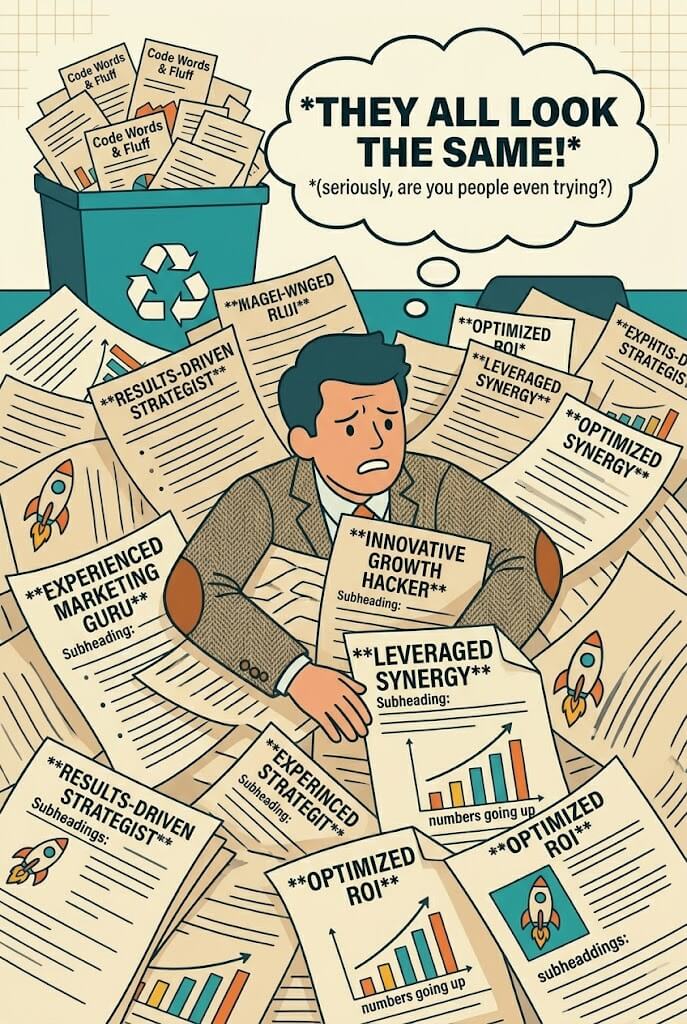 As I worked through the resumes, massive patterns started to emerge almost immediately. Most applicants were shockingly bad at communicating what they actually do. Instead of explaining their work clearly, people relied on vague language, buzzwords, and recycled phrases that sounded impressive but said very little.
After a while, close to 80 percent of the resumes were effectively identical. Different names, same wording. It became incredibly difficult to tell who actually knew digital marketing and who just knew how to write something that sounded like digital marketing.
This role existed because I had helped the firm with digital marketing for years. When I moved to Colorado, I stepped away from that work, and they ended up relying on outside vendors. They were paying a lot of money and not getting much in return. No clear direction, no ownership, and no one internally who could really assess what was working and what wasn’t.
I told the managing partner that if they wanted real results, they needed someone full-time, in-house, who actually understood digital marketing. He agreed, and that’s how this position came to be. It was a six-figure role with real responsibility, not an entry-level job or a coordinator position.
The firm could have gone to a traditional recruiting agency to fill the role, which is what most companies do. The problem is that traditional recruiters almost never have real digital marketing experience. You end up with someone who’s never run a campaign, never touched analytics, and never had to make performance-based decisions trying to evaluate whether candidates actually know what they’re doing.
In digital marketing, that’s a huge problem. Too many people can speak confidently using big marketing terms, and if you don’t know the discipline yourself, it’s very easy to mistake vocabulary for competence.
The purpose of this article is simple: to share everything I learned from this process and explain how I’d recommend applying for digital marketing roles if I were on the candidate side today. I’m going to walk through what actually got people eliminated, what quietly moved people forward, and how hiring decisions were really made.
By the end, you should have a clear framework for writing a resume that makes sense to a real hiring manager—not one that blends in with hundreds of others using the same language and the same formulas.
What Got Resumes Eliminated Immediately
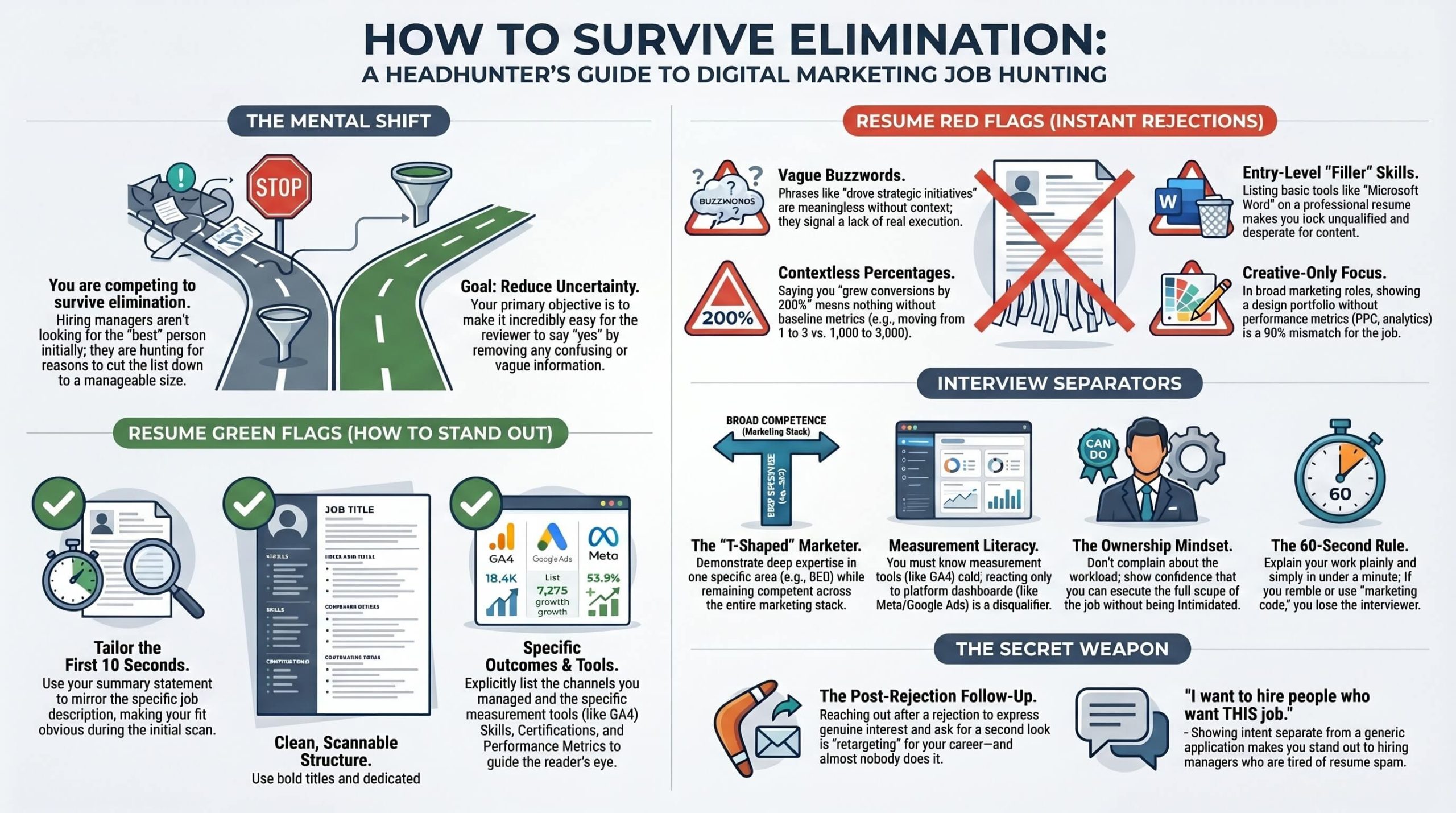
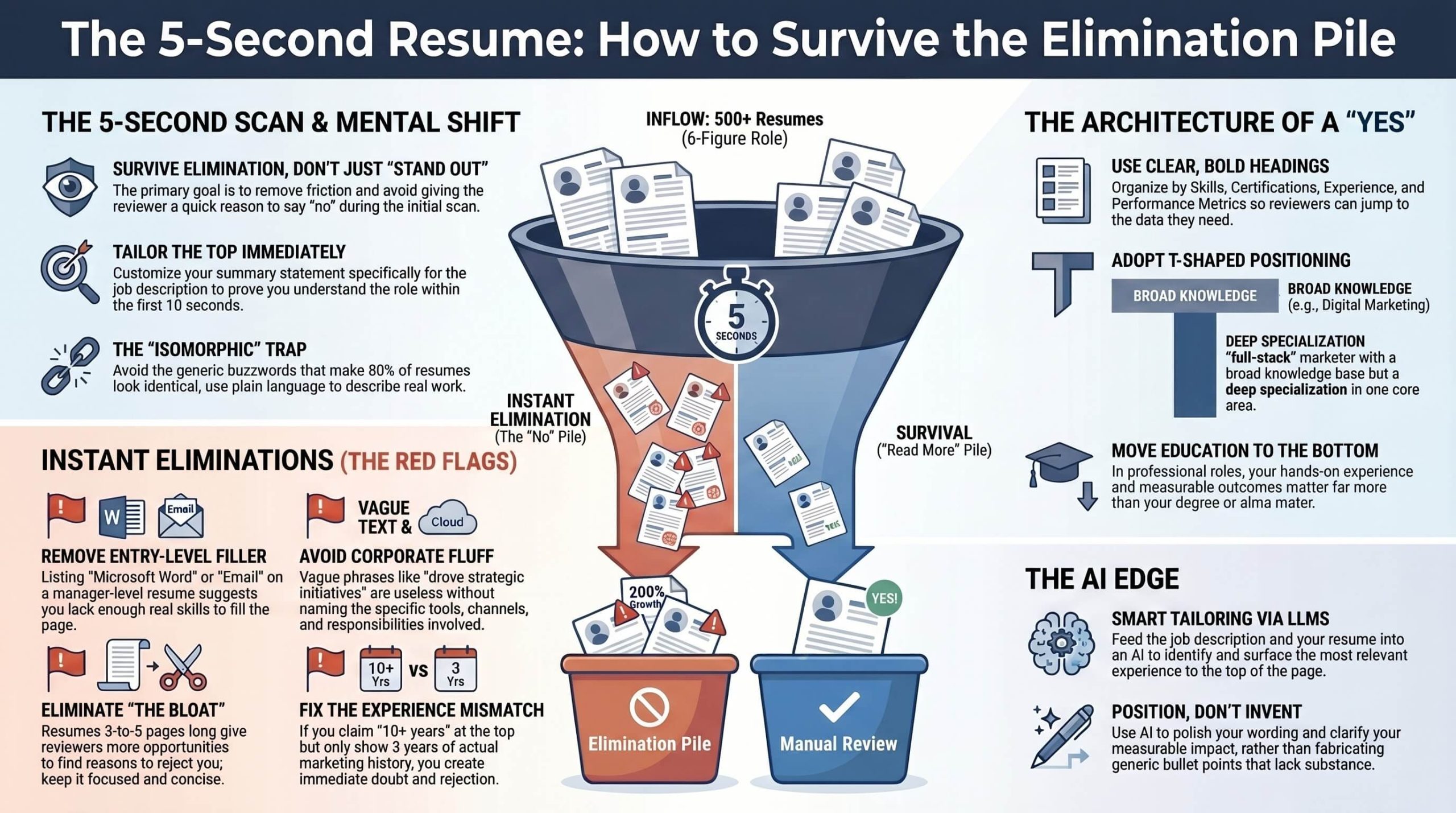
When you’re reviewing hundreds of resumes, nobody is reading every line. You have maybe five to ten seconds per resume on the first scan. I was looking for very specific signals, and if they weren’t there, the resume didn’t move forward.
A large percentage of applications were eliminated almost instantly for reasons that had nothing to do with intelligence or potential. They were eliminated because the resume made it clear the candidate wasn’t a fit for this job. Here are the most common elimination triggers.
Vague, Buzzword-Heavy Descriptions
This was the most common issue by far. Resumes filled with language that sounded impressive but explained nothing. Examples like “Drove strategic digital initiatives,” “Executed data-driven marketing campaigns,” or “Optimized brand presence across channels” showed up constantly.
They don’t tell me what you did, what tools you used, what you were responsible for, or what changed because of your work. After reading dozens of resumes like this, they all blur together. The resumes that moved forward explained things plainly.
They listed the channels they worked on, the tools they used, what they owned, what decisions they made, and how performance was measured. Clear beats clever every time.
 Percentages Without Context
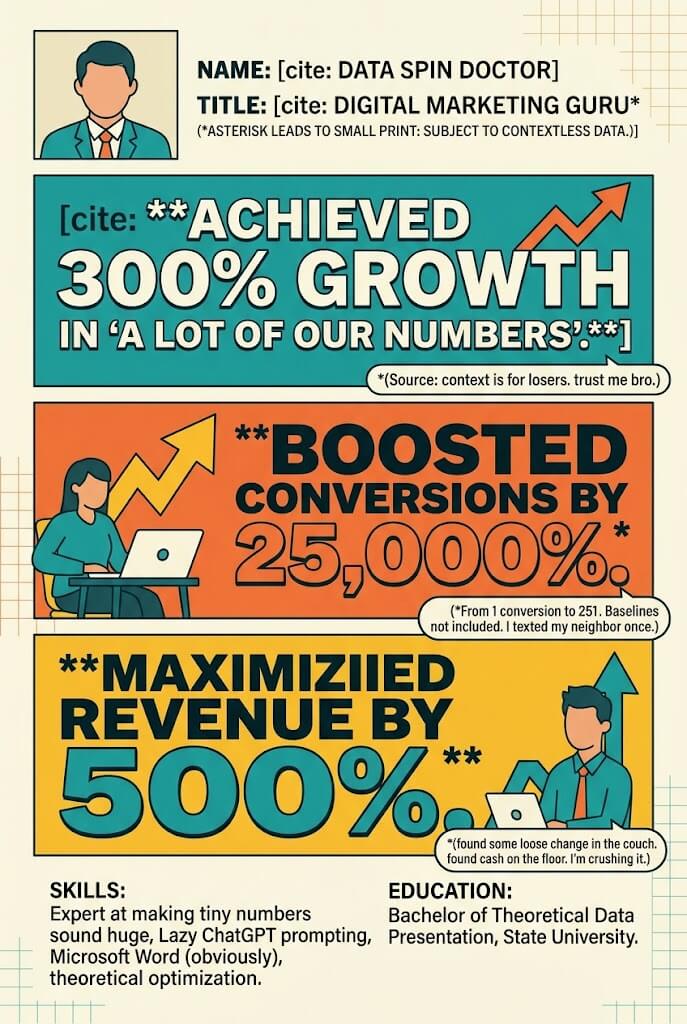
Saying you “increased conversions by 200%” means nothing without scale. Going from one conversion to two is technically a 200% increase. Going from 1,000 to 2,000 is something entirely different. Percentages without context are just as vague as buzzwords.
If you’re going to use numbers, include baseline, volume, and timeframe. Otherwise, they don’t help you.
Creative-Only Resumes for Digital Marketing Roles
Graphic designers, photographers, and videographers play an important role in digital marketing. But those skills by themselves do not make you a digital marketer. A huge amount of time was wasted reviewing resumes that were almost entirely creative portfolios.
If you can’t do 90 percent of the job description, it’s not a good look to apply. And if you actually do have marketing experience in addition to creative skills, your resume has to make that obvious immediately. In a five-second scan, if all I see is videography, that’s all I assume you can do—and you’re eliminated.
Entry-Level Filler on Mid-Level Resumes
Seeing things like “Microsoft Word,” “Excel,” or “PowerPoint” listed as skills was an immediate eye-roll—especially for a manager-level role. I’ve never met anyone in a business setting who doesn’t know how to use Word.
You might as well list “knows how to use the internet.” Even for entry-level candidates, this kind of filler hurts more than it helps. If you need content, certifications, projects, or measurable experience are far better uses of space.
Why Rejection Didn’t Always Mean You Weren’t Qualified
One thing that really stood out to me during the process was how few people followed up after being rejected. Out of more than 500 rejected resumes, only two people reached back out.
Both sent short messages saying, essentially, “I think I’m really qualified for this role. If you’d be open to taking another look or hopping on a quick call, I’d love to explain why.”
I did go back and re-review both resumes more carefully. They were still rejections, but if either had been wrongly eliminated, I would have caught it because they followed up.
There were several times I rejected resumes that I didn’t want to reject. I simply couldn’t interview everyone. In more than one case, I remember thinking, “I hope this person follows up.” Almost nobody did.
If a job actually matters to you, follow up. Hiring managers want to hire someone who wants the job—not someone blasting resumes everywhere. When candidates emailed the firm, every message was forwarded to me. None of it was annoying. It was a massive positive signal.
The Mental Shift: You’re Competing to Survive Elimination
Most applicants think the goal of a resume is to stand out. That’s not how hiring works when there are hundreds of applicants. The real goal is to avoid getting eliminated.
Once resumes move past obvious no’s, the eliminations become subtle. At that stage, small things matter far more than people realize. If your resume creates confusion, forces the reviewer to infer things, or raises unnecessary questions, you don’t move forward—not because you’re bad, but because someone else made it easier to say yes to them.
Resume Takeaways (Checklist)
-
Write your resume for the specific job you’re applying for, not as a generic document you send everywhere.
-
Use the personal statement / summary at the top to make your fit obvious within the first five to ten seconds.
-
Use clear section titles and subtitles so a reviewer can immediately jump to what they’re looking for.
-
Include a focused Skills section highlighting relevant platforms, tools, and systems.
-
If you need to fill out your resume, add a Certifications section—not because certifications matter much, but because it’s better content than filler.
-
Structure experience around responsibility and outcomes, not job descriptions.
-
Consider a Performance Metrics section that clearly spells out impact and scale.
-
Keep education short and to the point—it mattered far less than real experience.
-
Remove anything that doesn’t directly support the role.
-
Use plain language instead of buzzwords.
-
Provide numbers only when they include context.
-
Use modern tools to surface relevant experience, not invent it.
-
Apply to fewer jobs and put real effort into each one.
-
Follow up when you’re interested.
Interview Takeaways for Digital Marketing Roles
The interview process didn’t move quickly at first—it evolved. Early on, I scheduled longer interviews and spent a lot of time with the first few candidates. We went deep. Offers were extended. Some candidates declined based on compensation.
Others unraveled during background verification. Going through that forced me to reassess how I was evaluating people.
What I realized quickly was that I didn’t need long interviews. In most cases, I could tell in 60 seconds or less whether someone actually knew digital marketing. By the end of the process, 15-minute screening calls were more than enough.
Very basic questions were sufficient. Asking someone what they thought about GA4—even clarifying that I meant the current version of Google Analytics—exposed gaps immediately. Many candidates with years of “experience” hadn’t used it at all.
At the manager level, understanding measurement is non-negotiable. You don’t need to be an analytics specialist, but you do need to understand how performance is evaluated and how channels connect. Relying entirely on built-in platform analytics is not management.
People who knew what they were doing explained their work plainly. They could elaborate without getting defensive. People who didn’t leaned heavily on terminology. Vocabulary didn’t hold up under follow-up questions. Breadth mattered more than specialization.
The strongest candidates were T-shaped marketers who understood how all the systems fit together.
Mindset Was the Final Differentiator
We put a lot of responsibility into the job description. Some candidates immediately pushed back and said some version of, “That’s a lot for one person,” or implied that the scope wasn’t realistic. That was an easy way to remove yourself from contention. Not because the role was unreasonable, but because I knew exactly what the workload looked like—and I knew it was absolutely manageable.
In contrast, several candidates said the opposite. They were very direct: “I could absolutely do everything listed here, no problem.” That response immediately instilled confidence. Some were honest about areas they’d need to outsource occasionally. That was completely fine. I wasn’t looking for perfection. I was looking for ownership.
What I Was Really Listening for in Interviews
At the end of the day, interviews weren’t about trick questions or deep technical gotchas. They were about clarity, confidence, and basic professionalism.
You need to be confident in what you can do and able to explain it simply. If you’re rambling for more than 60 seconds trying to explain your role, your process, or your experience, you’ve already lost the room.
Strong candidates could explain what they did clearly, then elaborate when asked. Weak candidates talked in circles.
Confidence mattered, but exaggeration didn’t. The best answers were, “Yes, I can handle all of this,” paired with honesty about where someone might need to learn. Saying you haven’t done something before is perfectly fine—as long as it’s followed by confidence that you can pick it up quickly.
Being likable also mattered more than people realize. You don’t have to be the most charismatic person in the room, but you do have to be someone people want to work with. Be normal. Be polite. Smile. A surprising number of candidates came into interviews guarded, skeptical, or defensive.
You should be screening the role before the interview, not acting unsure once you’re already in it.
How you talk about your previous job matters, too. If you’re asked why you’re leaving and your answer is that your boss is an idiot, that’s an immediate red flag. Even if the situation is difficult, you need to spin that into a positive.
Saying you want to go somewhere you can focus purely on your skills rather than dealing with personalities is very different from just complaining.
Final Thoughts
This entire process reinforced one simple truth: most people aren’t rejected because they lack ability. They’re rejected because they don’t communicate it clearly.
If you understand how hiring actually works—how resumes are scanned, how interviews unfold, and how quickly weak signals eliminate candidates—you can dramatically improve your odds. Not by being louder. Not by using better buzzwords.
But by being clearer, more intentional, and easier to say yes to. That’s the difference between blending in and moving forward.